

accuracy with Euclidean and Chebyshev K-NN
Proof of Concept · Research × Safe Production
AI, counterfeit banknotes and DevSecOps in a proof of concept with academic rigor.
Lider Projetos turned a banknote classification study into a practical narrative about validation, overfitting, meta prompts and safe AI adoption in critical environments.
UNIFOR · Computer EngineeringMachine learning implemented from scratchDevSecOps for critical environmentsAssets ready for LinkedIn and Medium
Independent scientific research and technical demonstration material. It does not represent supply, approval or adoption by third parties.
accuracy with Multivariate Naive Bayes
test-speed gain of Naive Bayes over Euclidean K-NN
samples in the banknote authentication dataset
Applied research with a strong UNIFOR foundation and a clear path toward production.
The original delivery starts from an Artificial Intelligence study at UNIFOR, implements classifiers from scratch and then expands the discussion toward overfitting, meta prompts and AI approval in sensitive environments.
Origin
UNIFOR · University of Fortaleza
Artificial Intelligence course
Mateus Gomes
Connection
Academic research extended into a corporate and editorial layer by Lider Projetos
Prof. Cynthia Moreira Maia
- Source: UCI Machine Learning Repository · Banknote Authentication
- Samples: 1,372
- Classes: 762 genuine · 610 counterfeit
- Features: Variance, Skewness, Curtosis, Entropy
- Validation: 10-fold cross validation with random_state=42
K-Nearest Neighbors
An instance-based lazy family. It delivers peak accuracy when the dataset is well separated, at the cost of higher inference time.
- Euclidean · 100% accuracy
- Manhattan · 99.93% accuracy
- Chebyshev · 100% accuracy
Naive Bayes
A probabilistic classifier that becomes valuable when speed matters as much as robustness. The multivariate variant stood out by capturing correlations between features.
- Univariate · 83.97% accuracy
- Multivariate · 98.54% accuracy
- Inference time measured in milliseconds
The core thesis here is not just about counterfeit banknotes. It is about validating AI in critical environments.
The same discipline used to prove accuracy in classical machine learning must exist when a company wants to approve copilots, meta prompts and code-generation workflows. Without measurement, traceability and testing, AI in production is only a promise without governance.
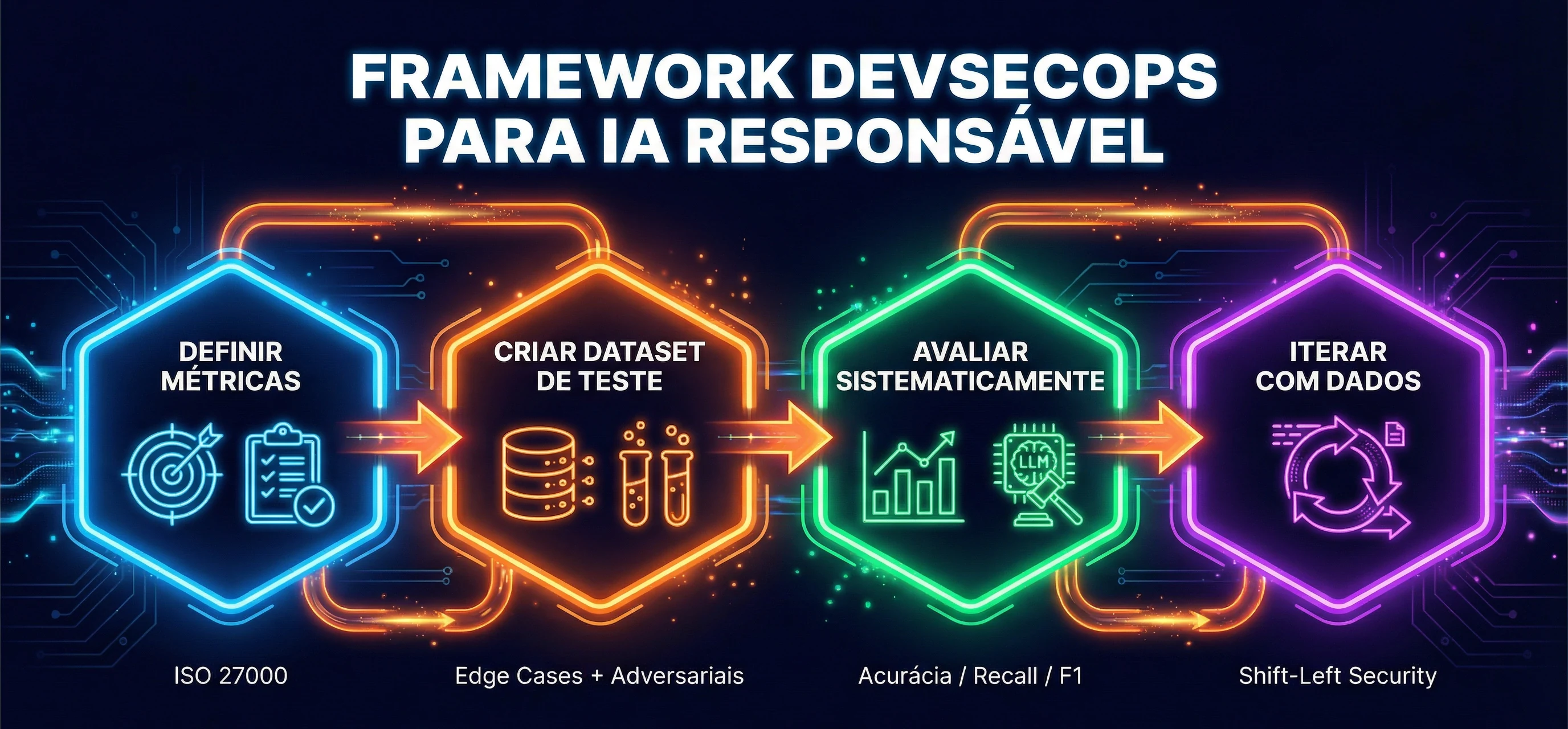
When a prompt works in two or three scenarios and fails outside the lab, the problem stops being creativity and becomes operational risk.
A safe design starts in requirements, moves through automated tests and ends in observability of what was generated.
PII, jailbreaks, context, auditability and compliance belong in the pipeline, not in a polished approval memo.
The Wavelet Transform was decisive in separating genuine and counterfeit patterns. In modern AI, the same logic applies to context, structure and input quality.
The gap between Univariate and Multivariate Naive Bayes shows that ignoring relationships between variables creates real performance loss.
100% accuracy is impressive, but inference time and transactional volume change the ideal production choice.
Euclidean or Chebyshev K-NN
For highly controlled validations with near-zero error tolerance, the K-NN family stood out with perfect classification in the experiment.
Multivariate Naive Bayes
When the problem involves high volume, latency and operating cost, the balance between 98.54% accuracy and a much lower response time changes the decision.
Naive Bayes for triage + K-NN for edge cases
This combination uses speed to filter the primary flow and reserves maximum accuracy for the most critical exceptions.
Publishing and distribution
Assets ready to turn the research into a public URL, presentation and positioning piece.
Lider Projetos branded presentation
An editorial version aligned with the brand, ready to use as a URL in LinkedIn, Medium or commercial conversations.
Open presentation in PT-BRDetailed report PDF
A branded PDF version of the visual report, designed for attachments, archiving and professional circulation.
Download branded PDFLight report PDF
A cleaner light-background variant, suitable for internal review, printing and lower-ink circulation.
Download light PDFBrowsable visual report
A dedicated slide route optimized for review in the browser before exporting the report variants.
Open visual reportEditorial abstract article
A more narrative and publishable read, with market context, a DevSecOps thesis and language suitable for public distribution.
Read abstract articleAbstract article PDF
A file ready for LinkedIn or short whitepaper circulation, keeping the same editorial direction as the web route.
Download abstract PDFEditorial angle for LinkedIn and Medium
The narrative links UNIFOR, mathematical rigor, overfitting, meta prompts and DevSecOps to position the research as both a technical and market argument.
Use this public URLConnection to Lider Projetos
This proof of concept shows how the company turns academic study into a visual layer, public interface, content strategy and technical positioning.
Talk to Lider Projetos